Reading conference questions help a teacher hear how a student is making meaning from a self-selected book. Start with “What is happening or being explained here?”, follow with “What in the text helped you think that?”, then use the answer to choose one small next step.
It is a conversation, not a checklist of every question. You do not need to have read every student's entire book: ask the student to orient you and show the pages being discussed. Keep in mind that one short conversation does not verify whole-book understanding; it gives you a useful sample of how the reader is thinking right now.
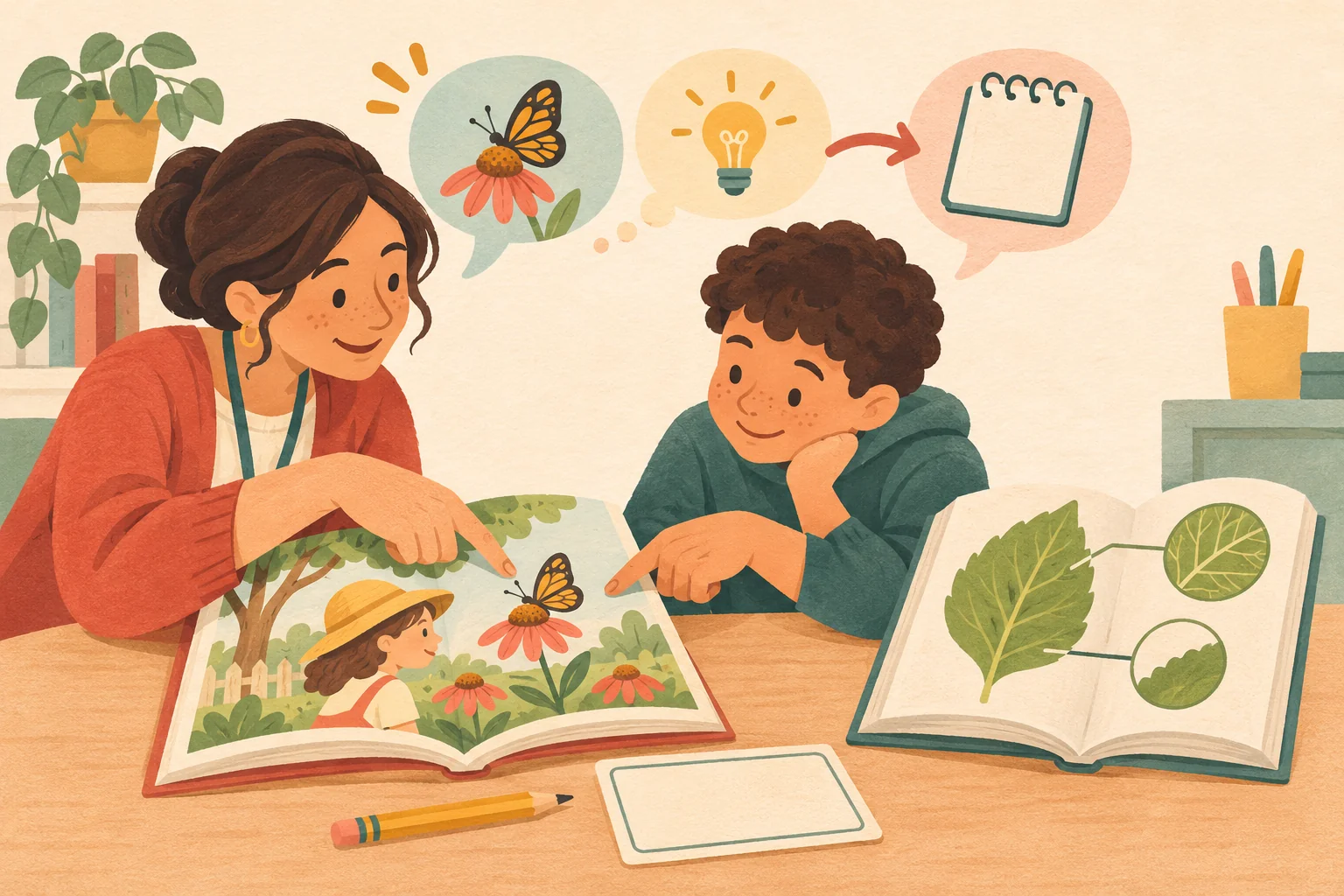
A short conference: orient, listen, follow up, teach
As a starting plan, reserve three to five minutes for one focused conversation, then adjust to the reader and your classroom. This is a planning suggestion, not an established benchmark. One possible routine:
- Orient. Ask which book and part the student is reading, and what is happening or being explained there.
- Listen for evidence. Invite the student to explain their thinking and show what in the text supports it.
- Follow up. Respond to what the student actually said rather than moving to a predetermined next question.
- Teach one move. Model or practice one useful strategy, then agree on what the student will try next.
Keep the book open throughout. Pointing to a page keeps the conversation about the text, not about memory.
The International Literacy Association's ReadWriteThink strategy guide on supporting students while they read recommends talking with independent readers about meaning and their interests, and noting how they solve problems as they read. The question groups and worked example below are our practical applications of that idea, not quoted research findings.
Fiction conference questions
Choose one group that matches the pages the student is reading.
Orient to the scene
- What does the character want in this part?
- What changes in this scene?
- How does this connect to an earlier event?
Make an inference
- What might the character be feeling, and which detail suggests it?
- Why did the character make that choice?
- Could another explanation fit? What would support it?
Think across the book
- How has the character changed so far?
- Which earlier detail seems important now?
- What idea is the story exploring? Show a moment that fits.
Match the question to where the reader is. A student in the middle of a chapter book can talk about an idea the story seems to be exploring so far; do not demand an end-of-book theme before they have reached the end.
Nonfiction conference questions
Informational text works differently, so choose questions that fit its structure rather than forcing story questions onto it.
Main idea and detail
- What is this part mainly explaining?
- Which detail most helps explain it?
- How would you explain it without copying a sentence?
Text structure
- What causes this change?
- How does this diagram or caption add to the paragraph?
- How are these ideas alike or different?
Monitoring understanding
- Which word or sentence was confusing?
- What did you do to make sense of it?
- What does the author explain, and what is still unanswered?
A cause-and-effect chapter suits structure questions; a dense section with new vocabulary may call for monitoring questions first.
Follow the response, not a script
The student's first answer tells you which follow-up will be most useful. Four common responses and a next move for each:
- Retells every detail. Ask, “Which event or piece of information would someone need to understand the rest?” If needed, model a concise summary of one section.
- Gives an opinion without evidence. Ask the student to locate the exact moment or detail, then explain how it connects to their opinion.
- Says “I don't know.” Narrow the focus to one paragraph or illustration, reread it together, and offer a stem such as “I think… because…”. A slow spoken response is not the same as poor comprehension.
- Gives a convincing answer. Explore an alternative explanation or a relationship between ideas rather than asking for more and more details.
If word reading or vocabulary is blocking meaning, support that first before asking more inference questions. These are instructional observations to guide your next step, not diagnoses.
A worked conference
Original practice passage
“Mara carried the class seedlings to the sunny window. By lunchtime, the leaves had begun to droop. She touched the dry soil, filled a small cup, and watered each pot. The next morning, she moved a notebook off the windowsill so every plant had space.”
Teacher: What did Mara notice, and what did she do?
Student: The plants were sad, so she helped them.
Teacher: Show me the details that make you say they needed help.
Student: The leaves drooped and the soil was dry. She watered them.
Teacher: You used two details to explain her action. What might the notebook move tell us?
Student: She wanted them all to fit by the window.
“Sad” is a childlike word, but the explanation makes sense once the student points to the drooping leaves and dry soil. Separate the comprehension evidence from the wording, and do not penalize the word choice.
Notice what the passage does and does not support. It shows Mara caring for the plants and making space for them; it does not prove a scientific cause for the drooping or show that the plants recovered.
Teaching move: connect a character's action to an observed detail. Next independent try: mark one detail that explains a character's choice before the next conference.
Adjust support without changing the goal
- Younger or less confident readers can point, sketch, sequence pictures or speak before writing. The meaning goal stays the same.
- Multilingual readers may rehearse in a familiar language, use gestures or diagrams, and work with one prompt at a time. Check their reasoning separately from their English output.
- Fluent talkers deserve the same evidence question as everyone else: a more fluent explanation does not automatically mean stronger comprehension.
- Advanced readers can compare plausible interpretations and weigh the evidence for each, rather than simply giving longer answers.
Keep a small conference record
A short note helps you plan the next conference. Use this template on paper or in your own notes, and keep student notes private.
- Date / student identifier
- Keep notes private.
- Book and pages
- The part discussed.
- Focus question
- The one idea you wanted to hear.
- Evidence observed
- A short paraphrase or student response; note whether it was independent or prompted.
- One teaching move
- What you modeled or practiced.
- Next check
- What to look for and when.
An illustrative record for the Mara conversation:
- Focus
- Explain a character's action.
- Evidence
- Gave two details (drooping leaves, dry soil) after a prompt to locate them.
- Teaching move
- Connect an action to an observed detail.
- Next check
- One independent explanation in the next conference.
Descriptive notes like these are more useful for planning than a numerical score.
Make conferences fit the reading block
Ask each student to bring their book and one chosen passage to the conference. Rotate planned conferences with brief, needs-based check-ins, and keep the routine for other readers clear so the rest of the class can keep reading.
For scheduling, see how to manage students reading different books. For a broader view, read about assessing independent reading across different books.
One short check is a sample. Combine it with other reading work over time rather than using it as a high-stakes judgment.
Add a written check when you need one
The conversation comes first. When you want a separate short written check on selected pages, ReadCheck can turn photos of those pages into questions you review before use.
A page-specific quiz complements discussion rather than replacing it, and it does not establish whole-book understanding.
Related: reading log alternatives and tools for tracking comprehension across student-selected books.