Good homeschool reading comprehension questions help your child explain what the text says, connect its ideas, and show what supports an answer. Start with three prompts: What happened or what did you learn? Why does it matter? Which part of the book helped you decide?
You do not need to ask every question below. Pick a few that fit today's chapter, picture book or nonfiction selection. A short, thoughtful exchange gives you something useful to teach from while leaving room for your child to enjoy the book.
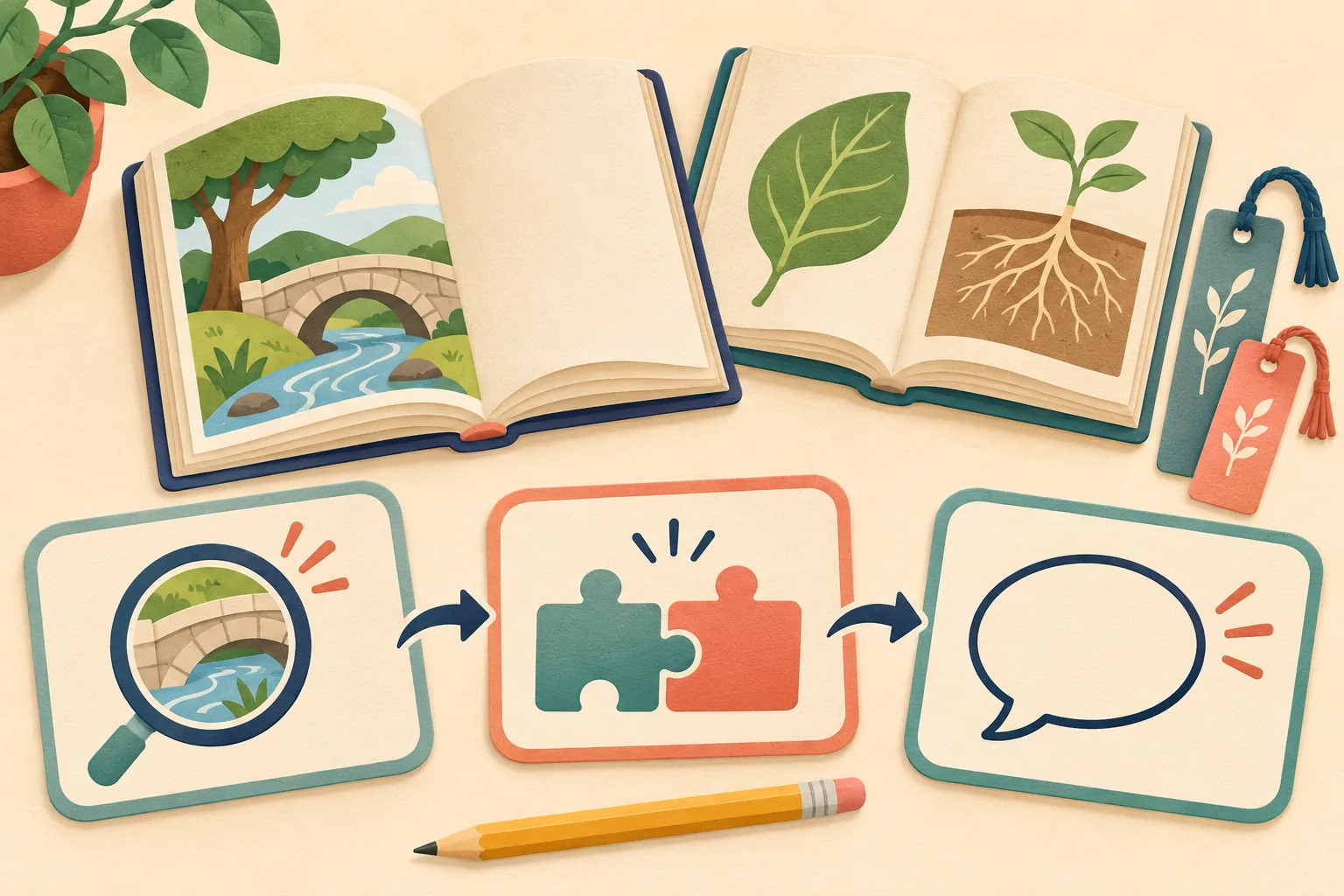
A three-question starting point
- Tell me the most important thing in this section. For a story, ask about the event that changed something. For nonfiction, ask for the main idea rather than every fact.
- How do these parts connect? Ask why a character acted, how one event led to another, or how two facts explain an idea.
- Show me what helped you answer. Your child can point to an illustration, reread a sentence, or explain a detail from memory and then find it together.
Keep the book open. Returning to the text makes the conversation about understanding, not about winning a memory contest.
The Institute of Education Sciences' K–3 comprehension toolkit recommends matching discussion to the text, teaching purpose and reader, and using follow-up questions to deepen discussion. This guide applies that approach to a homeschool conversation.
Fiction questions: events, motives and meaning
Choose from these question groups rather than treating the list as a quiz to finish.
Find the thread
- What does the main character want in this part?
- What gets in the way?
- Which event changes the situation?
- How would you retell this section in three connected steps?
Read between the lines
- What might the character be feeling? Which action or words suggest that?
- Why do you think the character made that choice?
- What does one character understand that another does not?
- What do you predict will happen next, and what in the chapter points that way?
Think across the story
- How is the character different from the beginning?
- Which earlier detail matters more now?
- What idea about friendship, fairness, courage or another theme does the story explore?
- If you changed one decision, what else in the story would need to change?
For a picture book, let your child use both the words and illustrations. For a longer novel, name today's chapter or scene so the task has a clear focus.
Nonfiction questions: ideas, explanations and evidence
Use the questions that fit the structure of the selection.
Find the main idea
- What is this section mostly explaining?
- Which two details help explain that idea?
- What did a heading, caption or diagram help you understand?
- How would you explain the section to someone who has not read it?
Connect the information
- What caused this event or change?
- How are these two things alike and different?
- What happens first, next and last in this process?
- How does the example help explain the author's point?
Look closely
- Which word is important here, and what nearby words help explain it?
- What evidence does the author give for this claim?
- What question does the section answer, and what question is still open?
- What would you look up next to learn more?
A science process, biography and history chapter will not need the same mix. For a biography, combine questions about events and decisions with questions about the information the author provides.
A worked example: turn a short answer into a useful explanation
Original practice passage
“On Saturday, Leo found that the footbridge to the garden was closed. He could see the seed trays on the other side, but the sign said a board was loose. He started toward the shallow stream, then stopped when he saw how quickly the water was moving. He took the longer path past the library instead. When he arrived, he put a note beside the trays: Use the library path today.”
Ask: What problem did Leo face?
Possible answer: The bridge to the garden was closed because a board was loose.
Ask: Why did he choose the library path?
A short answer might be: Because it was better.
Follow up: What did Leo notice before he chose it?
A stronger explanation: The bridge had a loose board and the stream was moving quickly, so he chose the longer path.
Ask: What does the note suggest about Leo?
Possible answer: He wanted other people to know another way to reach the garden. The note tells them to use the path he took.
The useful move is the follow-up. “Because it was better” gives you a starting point; asking about his observations brings the answer back to the passage.
Try a different response format: have your child draw the bridge, stream and library path, then explain the choice. Keep the reasoning question the same.
One shared book, different levels of support
When siblings hear the same read-aloud, give them the same big idea but different ways to respond.
For the Leo passage:
- More support: “Point to the route Leo took. What made him stop at the stream?” Reread that sentence together if needed.
- Growing independence: “Explain why Leo chose the longer route. Use two details.”
- More stretch: “What can we infer from the note? Explain why your interpretation fits the passage.”
Let one child speak, another draw and label, and another write a paragraph. Then compare the ideas, not the amount of writing. If everyone is reading a different book, reuse the question type but anchor it in each child's pages.
For a full teaching sequence, see how to teach reading comprehension with the books you already own.
What to do when the answer is vague
If your child says “I don't know,” narrow the task before adding more questions.
- Locate: “Let's find the part where the problem begins.”
- Reread: Read that small section together.
- Model: “I noticed this detail. It makes me think...”
- Return: Ask the child to finish the explanation or find a second detail.
If a word blocks the meaning, discuss it in that sentence and try the question again. If the explanation is already clear, move to a deeper question instead of asking for more details simply to prolong the check.
End with one next step: revisit a confusing paragraph, compare two characters, or carry a prediction into tomorrow's reading. A homeschool reading comprehension routine can build this into a weekly routine.
Keep a small record that helps tomorrow
A quick note can capture more than “finished chapter”:
- Book/pages
- Today's selection.
- Question
- The one idea you wanted to hear.
- Evidence
- A sentence your child said or a short work sample.
- Next step
- What you will revisit or extend.
For example: “Leo passage / explain a choice / connected the loose board and fast stream after one prompt / next time ask for two details before offering a prompt.”
Keep your question bank separate from progress notes. The bank saves preparation; the note helps you choose the next teaching move. See homeschool reading log vs. comprehension check.
Make questions from the pages your family is reading
These reusable prompts work when you want a conversation. When you want a ready-to-use check tied to today's physical-book pages, photograph them in ReadCheck to generate a comprehension quiz. Take the quiz in the app or print a worksheet and answer key for your homeschool lesson.
Keep choosing the books. Make the follow-up easier.
For an assignment-specific quiz, learn how to create a reading quiz from any book you assign.